


Applications
Start with the question
Every engagement begins with an ocean question. Here are a few examples the Ocean Digital Twin answers, each as a simulation you can watch. Filter by where you work, or just browse through. But there is way more the twin can resolve for you. If your question is not here, tell us what it is.
15 questions
- pCO₂ · µatm
How will carbon chemistry vary over the coming weeks?
Track how surface-water CO₂ and pH shift across a basin as eddies stir it, day by day: the number a carbon project reports and a shellfish grower watches.
- Connectivity
Will particulate matter or dissolved tracers from your operations reach neighboring areas?
Assess how particulate matter disperses and connects to neighboring areas.
- Deposition footprint · mm
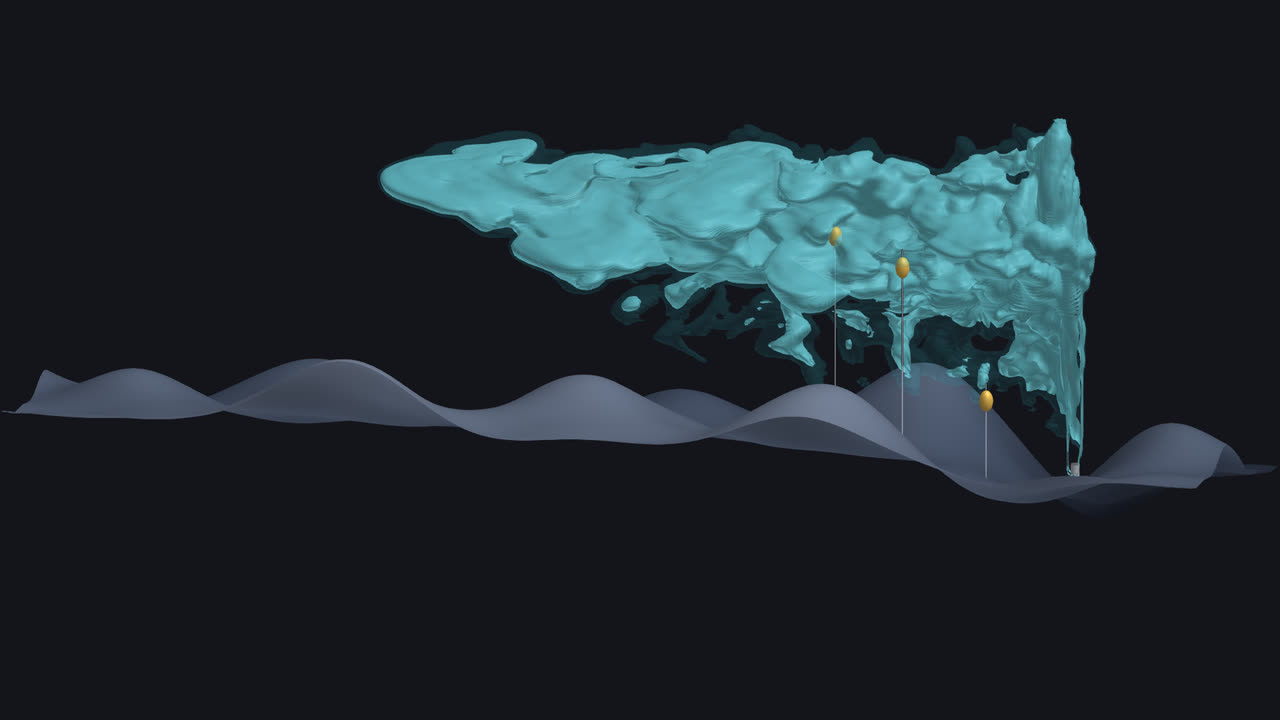
Where does the sediment from this disturbance settle?
Resolve where a plume travels and where it lands, for a collector on the abyssal seabed, a tailings outfall, or a dredged-material disposal site. Extent reported against the threshold.
- Dilution · recirculation
How does this discharge dilute, and does it come back to the intake?
Resolve a discharge from the pipe to the far field on the real bathymetry and tides: near-field mixing, the plume's path, and how much returns to the intake or the site. For outfalls, desalination brine, alkalinity dosing, and return water.
- Tracer transport · concentration
Where will the currents carry this over the next week?
Follow anything the water carries (a spill, larvae, a bloom, a dissolved tracer) through the real, resolved circulation.
- Temperature · °C
How does this bay respond to a marine heatwave?
Watch stratification and heat build through a warming event, at the scale you operate.
- Current speed · m/s
How strong will currents be in the next 48 hours?
Make informed decisions about micro-relocations by anticipating current patterns over the next 48 hours.
- Validated compliance & performance metrics
What is actually happening around my operation, and can I prove it?
A complete, continuous picture of the operation and the water around it: the twin run on what was actually done, validated against the moorings, and reported as the compliance and performance metrics that matter to your regulator, registry, or investors.
- Circulation · stratification · carbonate chemistry · ocean dynamics
What does the site look like before you deploy your operation?
Compile and curate the data that already exists for the region, identify the gaps that matter for characterizing the site and validating the model, and turn them into baseline monitoring recommendations that close those gaps before operations begin.
- Footprint vs. performance · per scenario
Which design, placement, or operating pattern gives the smallest footprint for the most performance?
Compare designs, sizes, placements, and operating patterns by what each one does in the water: an intake and outlet sized and sited to avoid recirculation, a collector or discharge depth chosen for the smaller plume, a mining or dredging pattern that stays within thresholds. Decided before the equipment is built or the permit is filed.
- Volume & area above threshold · over time
How much water and seabed does the operation affect over its life, and for how long?
Carry the operation forward, season by season, and track the volume of water above a concentration, pH, or oxygen threshold and the seabed area above a deposition threshold, at every milestone year. Cumulative impact stated against the threshold rather than extrapolated.
- Efficiency & footprint vs. scale
What happens when the pilot scales to full production?
Sweep the operation from pilot to target scale, each scenario against its counterfactual, to find where added capacity starts interfering with itself and what sets the site's ceiling.
- Wake deficit · stratification
How do turbine wakes change mixing across the array?
Turbulence-resolving simulation of wakes acting on a stratified shelf, returned in the form a regional model can use.
- Dissolved O₂ · mg/L
Will oxygen drop below the limit at the pens this week?
Forecast oxygen, temperature, and stratification through the whole farm and water column days ahead, and test a mitigation before committing to it.
- Lateral export · POC & DOC
How much of the meadow's carbon leaves as particles and dissolved carbon?
Resolve the fluxes a core or a satellite cannot see: export off the meadow and air–sea exchange, so the service a meadow provides is counted whether or not its biomass changes.
Don't see your question?
If your work depends on knowing what the ocean is doing, a digital twin can resolve it. Tell us the problem.
Talk to the team